
Why Trauma Disrupts the Body’s Rhythm — and How It Can Be Restored


Why Trauma Disrupts the Body's Rhythm — And How It Can Be Restored
From Patient to Participant Through Somatic Practice and Ayurvedic Wisdom
Understanding the body doesn't give us control over everything that shapes our lives, but it can return us to the places where choice becomes possible again.
One of the things I notice again and again in my work is that many people arrive feeling as though they have somehow lost touch with their own rhythm.
They are often doing all the things they have been told should help. They may be exercising regularly, eating well, showing up to therapy, caring for others, working hard, and doing their best to keep life moving forward. Yet beneath all of this there can be a growing sense of exhaustion. Sleep doesn't feel as restorative as it once did. The mind remains busy long after the day has ended. Digestion becomes unpredictable. Rest feels difficult, even when it is desperately needed.
Of course, these experiences do not happen in isolation.
Trauma does not happen in a vacuum.
Our nervous systems are shaped not only by personal experiences, but also by the broader environments we live within — our families, communities, workplaces, cultures, economic realities, and the relentless pace of modern life. Many of us are navigating not only our own histories, but also systems that ask us to move faster, produce more, consume more, and remain connected long after our bodies have reached their capacity.
When we begin exploring trauma recovery, it is important to acknowledge this reality. Some of the conditions that shape our nervous systems are not ours to change.
And yet something equally important begins to emerge through healing.
As we deepen our understanding of the body, new forms of choice slowly become visible again.
Not control or perfection. Choice.
The choice to listen when the body is asking for rest.
The choice to notice what helps us feel supported and what leaves us feeling depleted.
The choice to create a little more rhythm in a world that often rewards the opposite.
This is where both somatic practice and Ayurveda have offered me valuable ways of understanding the healing process.
Ayurveda: The Sister Science of Yoga
Ayurveda is often referred to as the sister science of yoga.
Whilst yoga offers practices that cultivate awareness, presence, and connection, Ayurveda explores the conditions that help support balance within the body and mind. Together they offer a remarkably sophisticated understanding of what it means to be human.
What continues to interest me is how often these ancient teachings align with what we are now learning about the nervous system. Both recognise that healing is not simply about eliminating symptoms. It is also about creating conditions that support regulation.
In my experience, the body responds well to rhythm, consistency, nourishment, and experiences of safety. When these foundations are missing, many of us find ourselves working harder and harder just to keep up. Yet when they begin to return, something often starts to soften. The nervous system doesn't have to work quite so hard. Sleep may become a little easier. Digestion a little steadier. There can be a growing sense that the body is no longer constantly bracing for what comes next.
Perhaps this is why so much healing is not about doing more. It is about creating the conditions that allow the body to remember what regulation feels like.
Or put another way:
The body doesn't heal through force. It heals through rhythm.
Trauma and the Loss of Rhythm
Many people living with trauma describe a growing sense of unpredictability within themselves.
Sleep may become less reliable, digestion can fluctuate, and energy often seems to have a rhythm of its own. Some days there is plenty available; on others, even simple tasks can feel difficult. It can feel as though the nervous system is constantly adjusting, moving between periods of activation and exhaustion, never quite finding a place to settle.
From an Ayurvedic perspective, many of these experiences can be understood through the lens of Vata.
Vata is often described as the principle of movement and communication within the body. It influences everything from breathing and circulation to the movement of nerve impulses and thoughts. When balanced, Vata supports creativity, adaptability, and responsiveness. When excessive, however, the system can begin to feel scattered, overstimulated, and increasingly difficult to settle.
People often describe feeling anxious or restless, struggling to switch off at the end of the day, or finding that their mind continues moving long after their body is asking for rest. There can be a sense of feeling both tired and wired at the same time.
Many people navigating trauma recovery recognise some of these experiences.
Modern nervous system science may use different language, yet the observation is remarkably similar. When the body has spent a long time adapting to unpredictability, stress, or threat, it can become increasingly difficult to settle back into a rhythm that feels supportive and sustainable.
Why Vata Matters in Trauma Recovery
One of the reasons I find Ayurveda so helpful is that it offers a practical way of thinking about regulation.
Rather than focusing solely on symptoms, it invites us to consider qualities.
What qualities are currently dominating the system?
And what qualities might help restore balance?
Ayurveda teaches that Vata tends to increase through irregularity, overstimulation, rushing, excessive change, and chronic stress. It is not difficult to see how these same conditions can place enormous demands on the nervous system.
In the studio, I often see these patterns showing up in surprisingly ordinary ways.
People arrive exhausted, yet they are still pushing themselves through high-intensity workouts because they feel they should. They are eating lunch standing up, grabbing food between meetings, surviving on coffee, skipping meals, or choosing foods that leave them feeling even more depleted. Salads, smoothies, cold drinks, late nights, endless scrolling, rushing from one commitment to the next — none of these things are inherently problematic. Yet when a nervous system is already carrying a great deal of activation, they can sometimes add more movement to a system that is already struggling to settle.
From an Ayurvedic perspective, many of these habits share qualities that increase Vata: speed, stimulation, irregularity, dryness, and constant change.
What is often needed is not another strategy for optimisation.
It is something much simpler.
A little more warmth.
A little more nourishment.
A little more consistency.
A little more rhythm.
Because these things solve everything and they help create conditions where the body no longer has to work quite so hard to keep up.
What Helps Reduce Excess Vata?
If Vata is characterised by movement, speed, dryness, and change, then balancing Vata involves introducing qualities that help the body feel supported rather than pushed.
For some people this begins with food. Warm nourishing meals eaten at regular times can have a surprisingly settling effect on the nervous system. For others it may involve creating gentler transitions between activities, reducing unnecessary stimulation, or developing a more consistent relationship with sleep.
For many of the people I work with, movement also becomes part of the conversation.
Not necessarily more movement. Different movement.
Trauma-sensitive yoga, for example, offers opportunities to slow down, notice sensation, and reconnect with the body at a pace that feels manageable. TRE® can provide another pathway, allowing the body to gently discharge some of the activation it has been carrying and create more space for settling.
The practices themselves may differ, yet the underlying principle is often the same.
We are helping your body move from constant adaptation towards greater regulation.
If I were to simplify it, many Vata-balancing practices share three qualities: they bring warmth, they encourage slowing down, and they help restore rhythm.
These may sound like small things.
Yet for a nervous system that has spent years adapting to unpredictability, small and consistent often becomes powerful.
If You're Feeling Overstimulated, Start Here
From an Ayurvedic perspective, reducing excess Vata is often less about adding something new and more about returning to the conditions that help the body feel grounded, nourished, and supported.
Many Vata-balancing practices share three simple qualities:
Slow Down
Choose slower, gentler forms of movement
Allow more space between your activities
Eat without multitasking when possible
Notice when you are rushing
Warm Up
Choose warm, nourishing meals more often than cold foods
Enjoy warm drinks throughout the day
Take a warm bath or shower
Create warmth through connection, comfort, and rest
Find Your Rhythm
Eat meals at similar times each day
Create a consistent sleep and waking routine
Build small rituals into your day
Choose practices you can return to regularly
These are not rules, they are invitations. Small ways of helping your nervous system experience a little more predictability, a little more steadiness, and a little less pressure to keep adapting.
From Patient to Participant
Perhaps this is one of the most valuable contributions that both Ayurveda and trauma-sensitive yoga offer.
They invite us to move from being passive recipients of treatment to becoming active participants in our healing.
For me, this has never been about willpower or getting it right. It is more about developing a different relationship with the body.
A relationship with our rhythms.
A relationship with our sensations.
A relationship with the body's ongoing attempts to communicate what it needs.
This feels particularly important in trauma recovery because so many people have spent years learning to override those signals in order to cope, survive, care for others, or simply get through the day.
This is not about blaming individuals for the conditions they live within. It is also not about suggesting that healing is entirely within our control.
It is about recognising that understanding the body can illuminate the places where choice becomes possible again.
Perhaps that choice is creating a little more rhythm in the day.
Perhaps it is noticing that rest is needed before exhaustion arrives.
Perhaps it is choosing a practice that supports regulation rather than pushing harder.
Perhaps it is simply becoming curious about what helps the body feel supported.
These choices may appear small.
Yet over time they can begin to change our relationship with ourselves.
And that, to me, is where we begin moving from patient to participant.A Closing Reflection
Trauma recovery is rarely about forcing change.
More often it involves creating conditions where the body no longer has to work quite so hard to protect us.
When rhythm begins to return, many people notice subtle shifts. A little more steadiness. A little more ease. A little more capacity to meet what is here.
Perhaps healing is not always about becoming someone different.
Perhaps sometimes it is about creating the conditions that allow us to return to ourselves.
And sometimes that begins with something as simple — and as profound — as restoring rhythm.
Continue Exploring Somatic approaches
If this way of understanding the body resonates with you, you might enjoy my short online mini-course:
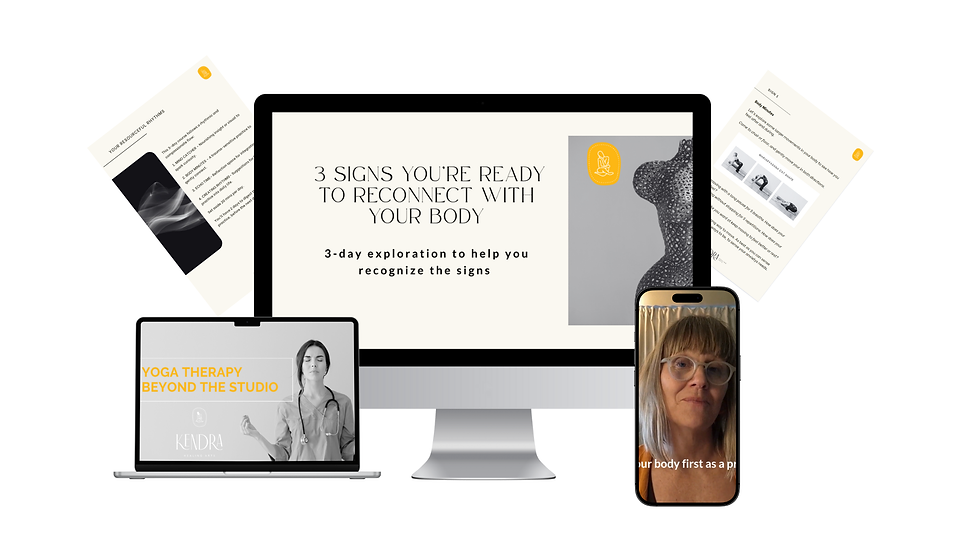
How to Recognise the 3 Signs You're Ready to Reconnect With Your Body in a Guided, Trauma-Aware Way
Together we'll explore why nervous system awareness matters, how trauma can shape our relationship with the body, and why body-based approaches are becoming increasingly recognised as an important part of trauma recovery.
It offers a gentle introduction to many of the ideas explored in this article and provides a pathway into the deeper work of the Safe to Feel Embodiment Program™.


Comments