
When Śavāsana Doesn’t Feel Like Rest

A trauma-sensitive, body-led pathway to settling the nervous system
“Within the aliveness of the relational field – despite the pain of the present, the traumas of the past, and the broken dreams of the future – you may see that it was only love after all, taking whatever form it must so that it may unfold itself into this world, in ways the mind may never understand.”— Matt Licata

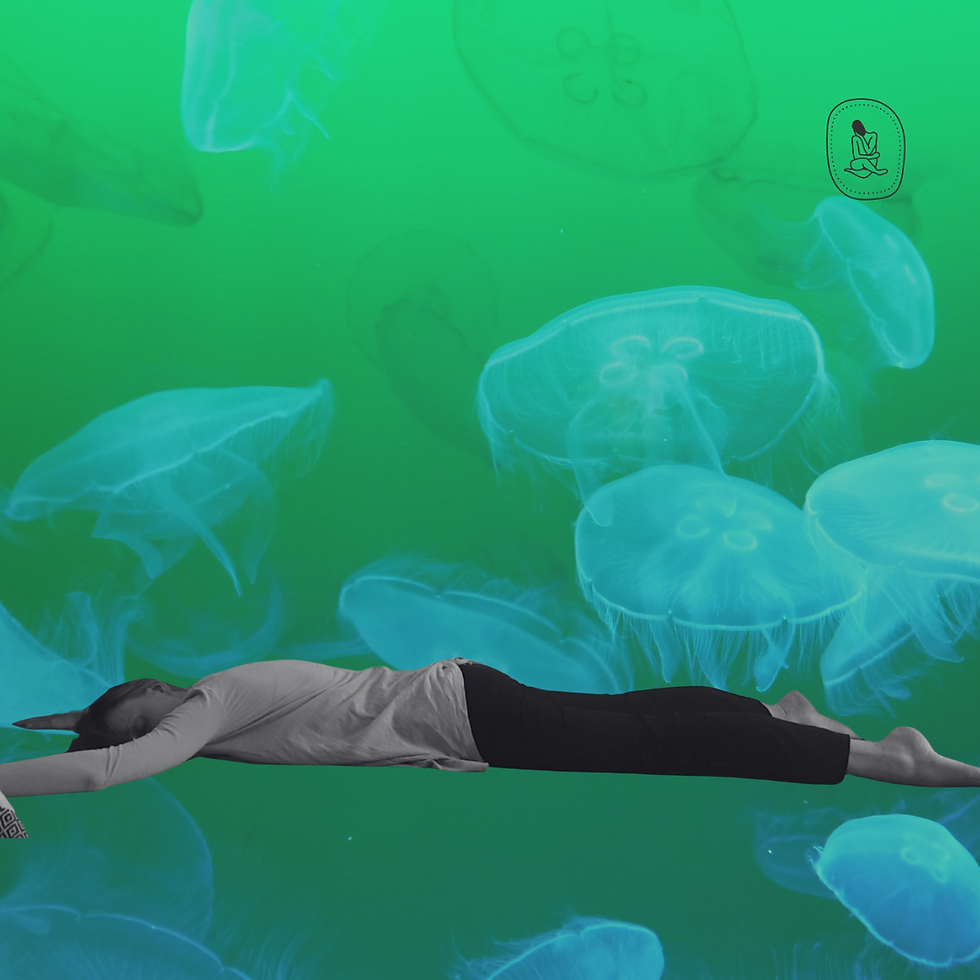
I remember lying in Śavāsana, completely still, but something in me was still moving — thoughts drifting, planning, a quiet restlessness underneath it all. For a long time, I thought I just wasn’t very good at resting.
What I understand now is something quite different. It wasn’t my mind getting in the way — my body simply wasn’t ready to rest. There were cycles still unfolding, movement not yet complete, activation still moving quietly beneath the surface. Rest wasn’t something I could arrive at… yet.
What Śavāsana is really pointing toward
By the time we arrive at Śavāsana in most yoga classes, we are often asked to be still before the body is ready. The shapes are done, the class is ending, and then we are invited to rest. But if there is still a hum of alertness in the system, stillness can feel uncomfortable, or simply out of reach.
Śavāsana, from śava (corpse) and āsana (posture), was described in the 15th-century Hatha Yoga Pradipika as a position that relieves fatigue and calms the mind. In yoga philosophy, it is understood as a practice of letting go — of effort, of holding, of identity — a space where your body can organise itself and your mind can quieten enough for a clearer, more grounded awareness to emerge.
A conscious kind of rest.
Not something we force, but something that becomes possible.
When stillness doesn’t feel safe
And yet, what if your body doesn’t feel safe?
For many people, Śavāsana is not the easiest part of the practice, but the most advanced. Not because it is physically demanding, but because it asks for something many bodies no longer feel familiar with — a sense of safety in stillness.
We live in a world that often rewards speed, responsiveness, and pushing through. Over time, many of us have learned to move away from our internal rhythms, to override what we feel, and to keep going. So when stillness arrives, it doesn’t always feel like rest. Sometimes it feels unfamiliar, or the mind continues on, or the body stays just slightly braced.
The space itself matters as well. Not all environments are trauma-sensitive. When there is little room for choice, when the environment doesn’t feel attuned, or when the body is unsure of what might happen next, it may stay quietly alert rather than settle.
When the conditions aren’t quite there
So when you lie down and something in you keeps moving — thoughts, sensations, a quiet restlessness — it may not be a problem to solve.
It may be that the conditions for rest, for surrender, for sleep are still unfolding. And sometimes, the space around you is part of that. When there is no room for choice, or the environment doesn’t feel attuned, the body may stay just slightly braced… waiting.
A different pathway — Shake & Śavāsana with TRE®
This is where Shake & Śavāsana with TRE® has been evolving — a practice I’ve been co-creating with participants, blending trauma-sensitive yoga therapy with TRE®.
Rather than moving directly into stillness, we work with rhythm. Simple yoga movements, brief pauses, shaking, and then rest — movement, shake, pause, movement, shake, pause — allowing your somatic experience to lead.
This creates a rhythm your system can begin to recognise — something that doesn’t ask you to override what is already there, but to move with it.
Finishing the cycles
Through this process, your body is given space to discharge what it has been holding, to complete stress responses, and to allow activation to move through rather than remain held beneath the surface.
This is about finishing the cycles.
Creating the conditions for rest
From here, Śavāsana becomes something else. Not something you are trying to achieve, but something your system is already moving toward.
Many of us are not lacking rest — we’re lacking the conditions that allow rest to happen.
And when those conditions are present, something begins to shift. A settling. An organising. A quiet return. This is where embodiment becomes real — not something to think about, but something you can feel.
Working with activation and anxiety, not against it
This practice is not about getting rid of anxiety.
It is about learning how to be with higher levels of activation without staying stuck there — sometimes without even realising it, until it shows up as impatience, overthinking, irritability, or the pull to keep going.
When your body is supported to move these states through, there can be more space, more choice, and a different relationship to what is arising.
A trauma-sensitive, choice-led approach
Recognising the reality of our minds and bodies in the room is central to this work.
Trauma-sensitive yoga therapy brings in choice-making, invitational language, and pacing that follows you. The ability to pause, adapt, or opt in and out is part of what allows your system to settle.
This includes working with neurodiverse ways of experiencing attention and focus, using rhythm, titration, and the senses so the practice meets you where you are.
A doorway into something deeper
Perhaps this is a kind of superhighway — not to Śavāsana alone, but toward samādhi, a state of integration where the separation between observer and experience begins to soften.
Not something to strive for, but something that becomes more accessible when the body feels supported enough to let go.
A note on what this can support
Emerging research in nervous system and somatic practices suggests that when the body is supported to complete stress responses — rather than override them — there can be positive effects on sleep, emotional wellbeing, and the ability to settle.
This is not about quick fixes, but about supporting the conditions that allow rest to become more available over time.

Shake & Śavāsana with TRE®
A trauma-sensitive, body-led practice
Wednesdays 5:30pm (in person or online)
This is not a foundational class. If you have already learned TRE® with me, you are very welcome to join. If not, the first step is to learn TRE® through a private session or introductory group, and from there, to build familiarity with your own tremoring response before joining.


Comments